Updated 2 July 2026
There are really only three approaches to protecting solar panels from birds — exclusion, deterrence and netting — and only one of them actually keeps pigeons out for good. Here's how they compare, and how to pick the right route for your roof and property type.
Birds nest under solar panels because the gap is a warm, sheltered, predator-free void. The only reliable protection is to physically close that gap with exclusion mesh — take the space away and the birds have nowhere to go. Deterrents and netting manage the symptoms at best; they don't remove the reason birds are there. The real decision isn't which gadget, it's who fits the mesh and on what kind of roof.
The 100–150mm cavity between your panels and the roof is ideal nesting habitat: shaded, elevated, dry and safe from predators. Pigeons in particular move in, breed year-round in Australia's mild climate, and leave behind droppings that corrode roofing, shade cells and create a genuine health nuisance below.
That's why chasing birds off never works for long — nothing about the site has changed, so they come straight back. We cover this in depth in why pigeons keep returning to solar panels. Effective protection has to remove the habitat, not just the birds.
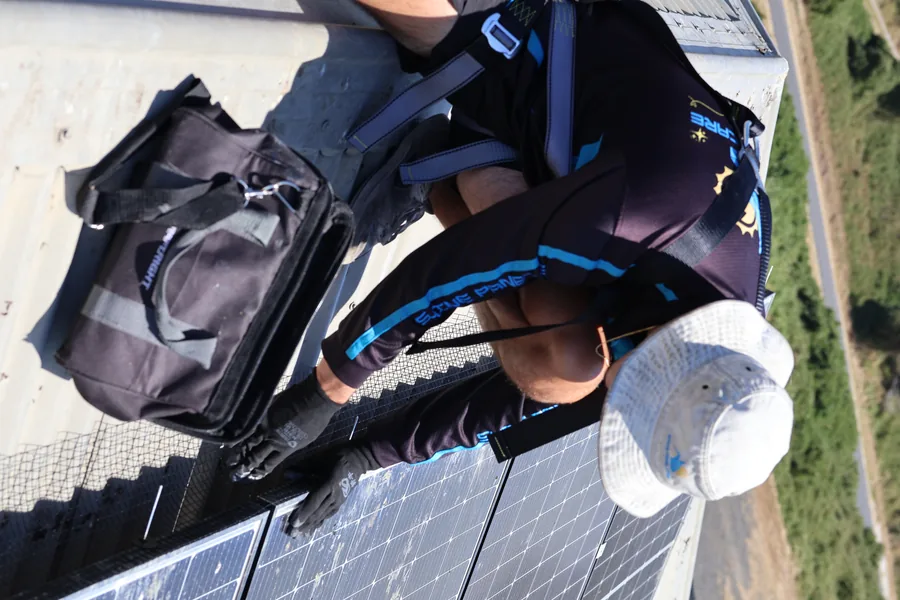
For the full product-by-product breakdown, see mesh vs netting vs spikes. In summary:
304 stainless mesh clipped around the panel perimeter closes the gap permanently, survives Australian conditions for a decade-plus, and doesn't touch the roof. The only method we warrant for 10 years, and the only one that ends the problem rather than managing it.
Spikes, gels, fake owls, reflective tape and ultrasonic devices target perching, not the under-panel gap. Pigeons habituate within days to weeks and walk straight past them. Cheap, but the problem never actually ends.
Bird netting suits balconies and large voids, not panel perimeters. It can't seal the gap cleanly, sags and UV-degrades, and can trap birds against the panels. The right product in the wrong place.
A capable DIYer can fit a DIY mesh kit ($180, 30m, shipped Australia-wide) using the install guide — or have us do it for a fixed price.
Leave the height to insured installers. Professional mesh installation is $23/m all-inclusive with nest removal, a completion report and full warranty.
Common-property roofs need SWMS, committee-ready fixed quotes and scheduling around residents — see strata solar bird proofing.
Large arrays, access plans and minimal disruption to operations — handled by our commercial solar bird proofing team.
Proper protection is a one-off cost, not a subscription. Professional mesh installation is $23 per linear metre of panel perimeter, all-inclusive — nest removal, fitting, completion report and warranty — which lands most Brisbane homes in the $350–600 band. A DIY mesh kit is $180 including GST for 30 metres of the same 304 stainless mesh, if your roof is safe to work on yourself.
Deterrents look cheaper up front, but spikes, gels and decoys need replacing as they weather and the nesting problem continues underneath — you pay repeatedly for a result that never arrives. For worked examples on small, medium and large systems, see the full bird proofing cost guide.
Bird protection is more than clipping mesh on. A proper job starts with measuring the panel perimeter and checking roof access, then a full clearout of nesting material and droppings — meshing over an active nest traps birds against your panels, so this step is never skipped. After heavy infestations, the area is decontaminated before sealing.
Only then does the mesh go on: 304 stainless steel, clipped to the panel frame with non-penetrative fittings that leave your roof and panel warranty intact, finished with a gap check around the full perimeter. Professional installs carry a 10-year product warranty plus a lifetime labour warranty; DIY kits carry the product warranty. That's the difference between bird protection that lasts a decade and a gadget that lasts a season.
Exclusion: epoxy-coated 304 stainless mesh clipped around the panel perimeter to close the gap birds nest in. It's the only approach that removes the habitat rather than just discouraging birds, and the only one that holds up for years in Australian conditions.
Not for the under-panel gap. Spikes only protect the ledge they sit on, and gels, fake owls and ultrasonic units rely on a fear response pigeons habituate to within weeks. They leave the nesting void open, so birds keep getting in.
A DIY mesh kit is $180 including GST for 30m. Professional installation is $23 per metre all-inclusive — nest removal, fitting, completion report and warranty. Both use the same 304 stainless mesh; the difference is who does the work. See up-front pricing for the full schedule.
The mesh is the same; the process differs. Strata and commercial work needs SWMS documentation, fixed committee-ready quoting and scheduling around occupants — covered by our strata and commercial services.
Installed correctly, 304 stainless exclusion mesh lasts well over a decade — ours carries a 10-year product warranty, and professional installs add a lifetime labour warranty. Deterrents, by contrast, typically lose effect within weeks as birds habituate, and weather within a season or two.
On a single-storey roof with a gentle pitch and safe access, yes — a DIY mesh kit with a step-by-step guide makes it a realistic weekend job. Anything two-storey, steep or awkward to access belongs with insured professionals: the cost difference is not worth a fall.
304 stainless exclusion mesh — the only bird protection we warrant for 10 years. $180 DIY kit or $23/m installed.