Updated 2 July 2026
Solar panel bird proofing cost comes down to one number: the linear metres of panel perimeter that need sealing with mesh. This guide shows the honest arithmetic — what a professional install runs on small, medium and large systems, what drives the price up or down, and when a $180 DIY kit is the smarter buy.
Professional bird proofing is priced per linear metre of array perimeter, not per panel. Our published rate is $23 per linear metre — mesh, clips, labour, nest removal and warranty all included — which puts most residential systems between $350 and $600 installed. The DIY alternative is a $180 kit (30 metres of the same 304 stainless mesh) shipped anywhere in Australia. Both routes and the numbers behind them are broken down below, so you can sanity-check any quote you're given.
Birds get in through the open gap around the edge of your solar array, so the job is to seal that full perimeter with exclusion mesh. That's why honest quotes are quoted per linear metre: measure around the outside of each group of panels, add the lengths together, and multiply by the rate. Panel count only matters because more panels usually means a longer perimeter — a 6.6kW system typically works out to 10–16 linear metres.
Our rate is $23 per linear metre including install, clips and warranty, published openly on our up-front pricing page, which also has an instant estimator for Brisbane installs. If you're comparing quotes elsewhere in Australia, ask for the per-metre rate and the inclusions — it's the only way to compare like with like.
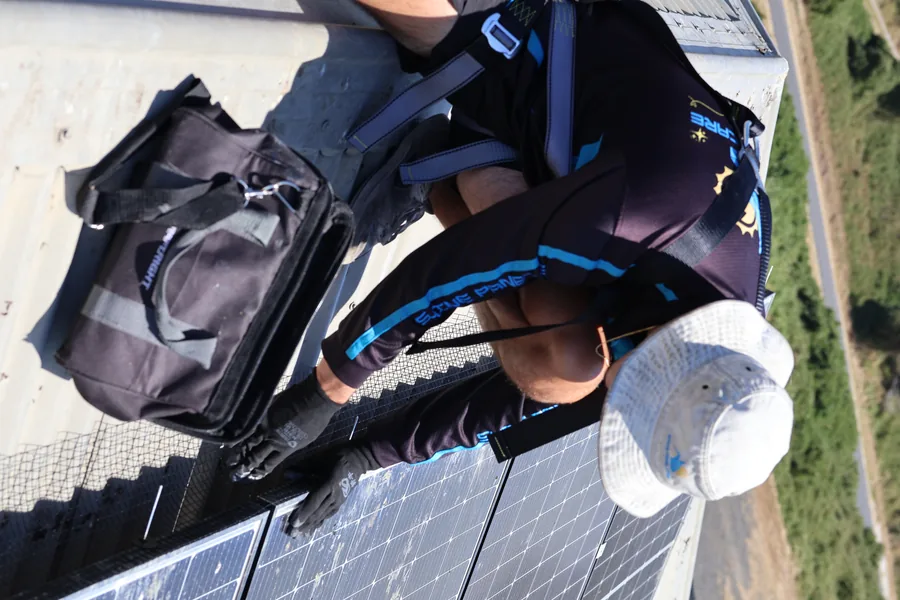
Three examples using our published $23 per linear metre rate. These are transparent calculations, not quotes — gaps, obstructions and layout can vary the final price.
A compact single array is roughly 10–13 linear metres of perimeter. At $23/m that's $230 to $299. Small, easy-access jobs like this sit at the bottom of the residential range.
The most common Australian install, typically 14–22 linear metres depending on how the panels are laid out. At $23/m that's $322 to $506 — which is why most residential totals land between $350 and $600.
Bigger homes with panels split over several roof faces can reach 26–30 linear metres of perimeter. At $23/m that's $598 to $690. Each separate array adds perimeter, so layout matters as much as panel count.
Two houses with the same panel count can get different quotes for good reasons. These are the factors any installer in Australia will weigh up.
One compact block of panels has less perimeter than the same panels spread across two or three roof faces. Split arrays mean more metres of mesh and more setup time.
Two-storey homes and steep roofs need more safety equipment and slower, more careful work. Many installers price this in; ask up front how height affects the quote.
Fragile or brittle tiles demand slower foot placement and sometimes tile replacement allowances. Metal roofs are generally quicker and cheaper to work on.
An active pigeon infestation means nesting material, droppings and sometimes dead birds to remove before mesh goes on. We include nest removal in our rate — many quotes don't.
Tight side access, no safe ladder position, or a roofline that needs harness anchor points all add time. Commercial and strata jobs may also need SWMS documentation.
Mesh grade, clips, nest removal, a completion report and a written warranty can each be an inclusion or an extra. A lower headline rate with exclusions often costs more in the end.
Both use the same epoxy-coated 304 stainless steel mesh and non-penetrative clips. The difference is who does the work — and what's covered afterwards.
All-inclusive: nest removal, custom fitting around cables and corners, photo and video completion report. Backed by the 10-year product warranty on mesh and clips plus a lifetime labour warranty on the workmanship. Available for Brisbane solar panel bird proofing and surrounds.
30 metres of the same 304 stainless mesh, a full set of clips and a step-by-step guide, shipped Australia-wide. Covered by the 10-year product warranty only — the labour, the ladder and the fitting are on you. See the DIY solar panel mesh kits page for full contents. In Tasmania? There’s a dedicated Launceston solar panel bird proofing guide for kit buyers.
On a typical home the gap between the two is a few hundred dollars. What you're buying with a pro install is the labour at height, the infestation cleanup, and accountability: if the workmanship ever fails, the lifetime labour warranty covers the fix. A DIY error — a missed gap, a loose corner — is yours to redo.
You have a single-storey home with a low-pitch roof you can access safely, a small-to-medium system, no active nesting to clean out, and you're comfortable working at height. $180 and a few hours seals the perimeter for good.
The roof is two-storey or steep, birds are already nesting under the panels, the system spans multiple arrays, or you don't have roof safety gear. Working at height to save a few hundred dollars is a bad trade — and an incomplete seal means the birds come back.
A suspiciously low bird proofing price usually isn't the same job at a better rate — it's a smaller job wearing the same name. The common corners cut:
Pigeon proofing and bird proofing are the same job — pigeons are the main culprit under Australian solar panels. Professionally installed exclusion mesh is $23 per linear metre at our published rate, which puts most homes between $350 and $600 all-inclusive. A DIY mesh kit is $180 including GST.
Our published rate is $23 per linear metre of array perimeter, including the 304 stainless mesh, clips, labour, nest removal and warranty, with GST included. Multiply your array perimeter by the rate for a working estimate — a typical 6.6kW system is 10–16 linear metres.
If birds are nesting under your panels, yes. Droppings shade cells and cut output, acidic mess corrodes roofing and wiring, and nesting material is a fire and pest risk — problems that recur every season until the gap is sealed. Quality mesh is a one-off cost carrying a 10-year product warranty, against a problem that otherwise keeps coming back.
Not when it's done properly. Quality mesh attaches with non-penetrative clips that grip the panel frame — no drilling, no screws, nothing touching the glass — so the panels and roof are left exactly as they were. Avoid any installer who drills or screws into panel frames, as that can void the panel manufacturer's warranty.
It depends on your policy, but many Australian home insurance policies exclude gradual damage and damage caused by birds or vermin — which is exactly how pigeon damage under panels happens. Check your PDS rather than assuming you're covered. Prevention is generally far cheaper than discovering an exclusion after the damage is done.
Because the inclusions vary. Mesh grade, clip type, nest removal, height access, completion reports and written warranties can each be included or charged as extras. To compare quotes fairly, ask every installer the same questions: what's the per-metre rate, what mesh is used, is nest removal included, and what warranty is in writing?
Our installation teams cover Greater Brisbane, Ipswich, Logan and Redcliffe. Anywhere else in Australia, the $180 DIY kit ships nationally with everything needed for a self-install, and this cost guide applies wherever you are — the perimeter arithmetic and the questions to ask an installer are the same in every state.
In Brisbane? Get a fixed-price quote at $23/m installed. Anywhere else in Australia? The $180 DIY kit ships to your door.