Updated 2 July 2026
You've chased them off. Maybe you've tried noise, spikes, or just hoping they'd move on. A few weeks later they're back — louder than before. The problem isn't effort. It's that nothing removed what was attracting them.
From a pigeon's perspective, the gap under a rooftop solar array is close to perfect. It's elevated, sheltered from Brisbane's afternoon storms and summer heat, warm from the panel absorbing sun, and largely undisturbed. Once a pair finds it, they don't need much encouragement to nest.
Brisbane's climate makes this worse than it might be elsewhere. We don't get cold winters that push birds off roofs or break nesting cycles. Pigeons here can breed year-round — up to six clutches annually in ideal conditions. A nest you clear in February can be fully re-established by April.
Dispersal — scaring birds away without removing the attractant — almost always fails long-term. There are three reasons.
Pigeons have a strong homing instinct and return to sites where they have previously nested successfully. Even after you remove visible nesting material, chemical traces remain on the roof surface and the underside of panels. The birds follow those back.
Pigeons raised under your panels treat that site as their territory. When they mature and start breeding, they return to the same location — sometimes within metres of where they were born.
Unless the physical access point is closed off, there is nothing stopping re-colonisation. Deterrents like plastic owls or reflective tape lose effectiveness quickly; pigeons habituate to static objects within days to weeks. See the full breakdown in our mesh vs netting vs spikes comparison.
Pigeon nests under solar panels aren't just unsightly. Accumulated nesting material — dry twigs, leaves, droppings — sits directly against DC cable runs and panel frames. In Brisbane's dry season, this is a fire risk. Cable insulation damage from uric acid in droppings has been documented as a cause of solar-related roof fires.
On top of that, bird droppings on panel surfaces reduce output. Even partial shading from a concentrated dropping on one cell can affect the whole string. Industry data puts average output loss from fouled panels at 15–25%, which adds up fast on a system you're paying off. Once the birds are excluded, a professional solar panel clean restores what the droppings have been costing you.
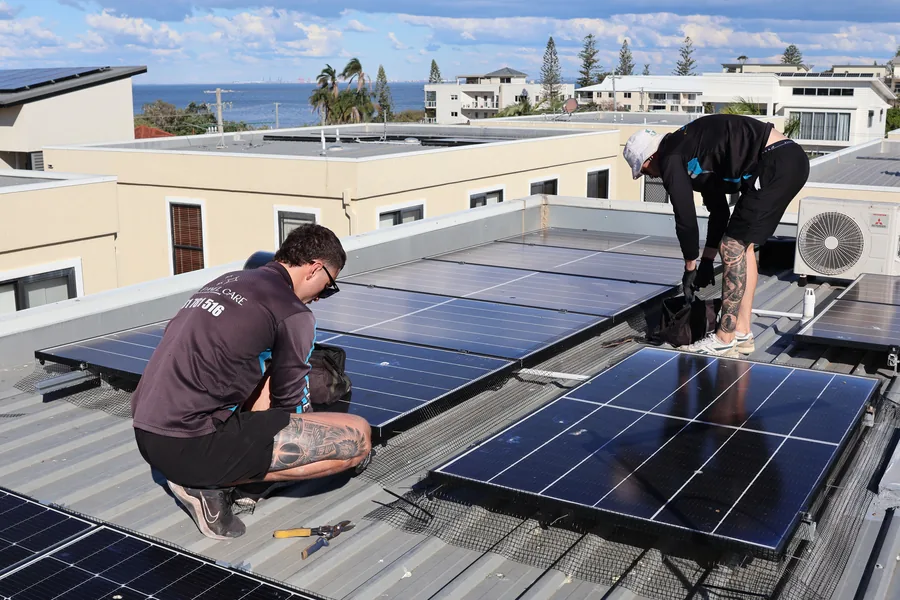
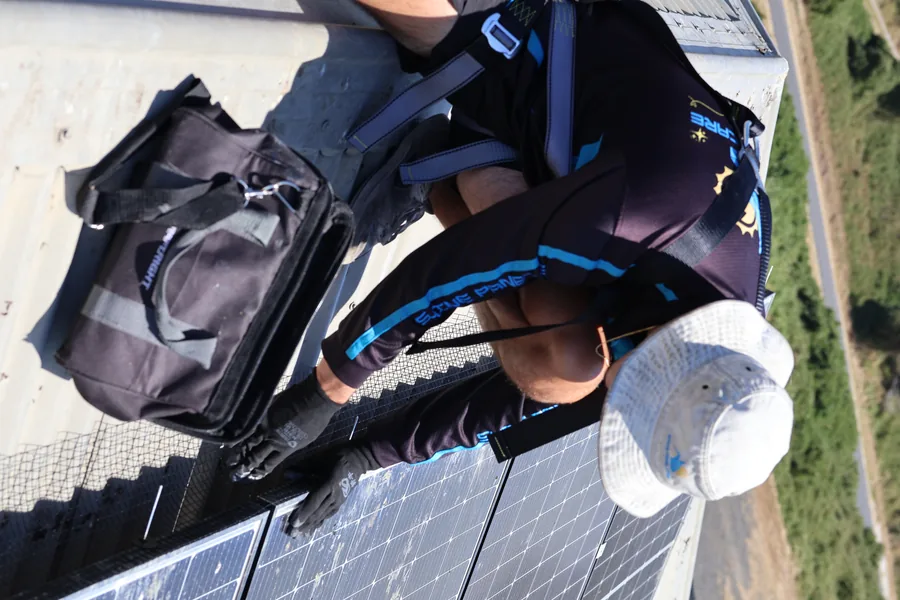
The only reliable solution is physical exclusion — closing the gap permanently so there is nowhere to nest. We install epoxy-coated 304 stainless steel mesh around the full perimeter of your solar array, using a no-drill clip system that attaches to the panel frame only. Confident on a low, safely accessible roof? The same materials come as a DIY solar panel mesh kit.
If pigeons are already nesting, the install is paired with a full clearout first: all nesting material, droppings and debris removed before the perimeter is sealed. Installing mesh over an active nest traps birds inside — so we never skip this step, and you don't need a separate pest contractor.
Often within weeks. Brisbane pigeons breed year-round, and both the original pair and birds raised at the site will attempt to return. Nest removal on its own is temporary — it only becomes permanent when the access gap is sealed at the same time.
Not for long. Pigeons habituate to static deterrents within days to weeks, and none of these products closes the gap under the panels — which is the actual attraction. Our guide on how to stop pigeons under solar panels covers what works and what doesn't.
Not through a correctly fitted perimeter. A pigeon needs roughly a 40mm gap, which is why corners and cable entry points are measured and fitted individually on every job. Material failure is covered by the 10-year product warranty, and our workmanship by a lifetime labour warranty.
The gap between the panels and the roof is warm, shaded, elevated and hidden from predators — close to ideal nesting habitat. Pigeons aren't drawn to the panels themselves but to that sheltered void underneath. It's the same reason they favour bridge ledges and roof cavities.
Yes, indirectly. Droppings are acidic and corrode panel frames, roof sheeting and earthing over time, and mess on the glass can cut output by 15–25%. Nesting debris traps moisture against the roof and birds can peck at wiring — a fault and fire risk on some systems.
Routinely — the under-panel cavity is one of the most common urban nesting sites in Brisbane. Once a pair settles in they breed repeatedly, and their offspring return to nest nearby, which is how one pair becomes a colony over a season or two.
Indefinitely, if nothing changes. Pigeons breed year-round in Australia's mild climate and reuse the same site for successive broods, so an untreated array can host nesting birds for years. The cycle only ends when the gap is physically closed.
Our $180 DIY kit ships Australia-wide with 30 metres of the same 304 stainless mesh we install professionally, the full clip set and a step-by-step guide. Product warranty included — the ladder and the labour are yours.
The mesh goes on once, the birds can't get back in, and the nesting cycle stops. From $23/m, all-inclusive.