Updated 2 July 2026
Dust, pollen, bird droppings and grime can quietly cut a solar system's output by 15–25%. Cleaning brings it back — but the wrong method scratches glass, voids warranties or sends people off ladders. Here's how to do it properly, and how to know when to leave it to a professional.
Clean on a cool, overcast morning when the glass isn't hot. Isolate the system, rinse with plain water, then wash gently with a soft brush or microfibre and — only if needed — a little mild soapy water. Rinse again and let it air-dry. Never use a pressure washer, abrasive pads, harsh detergents or cold water on hot glass, and never walk on the panels. If the array is on a two-storey or steep roof, don't risk the climb — book a pro.
Solar panels make power from light, so anything that shades the glass costs you output. A film of dust, tree pollen, sea salt or traffic grime can trim a few percent; heavy soiling, lichen or bird droppings can cut generation by 15–25%, and droppings that bake on will permanently shadow the cells beneath them.
Rain helps, but it doesn't clean a tilted panel properly — it runs off and leaves a tide-line of redeposited grime along the lower edge. That's why panels that "get rained on all the time" still test dirty. If birds are part of the problem, cleaning only treats the symptom; closing the gap with solar panel bird proofing stops the droppings at the source.
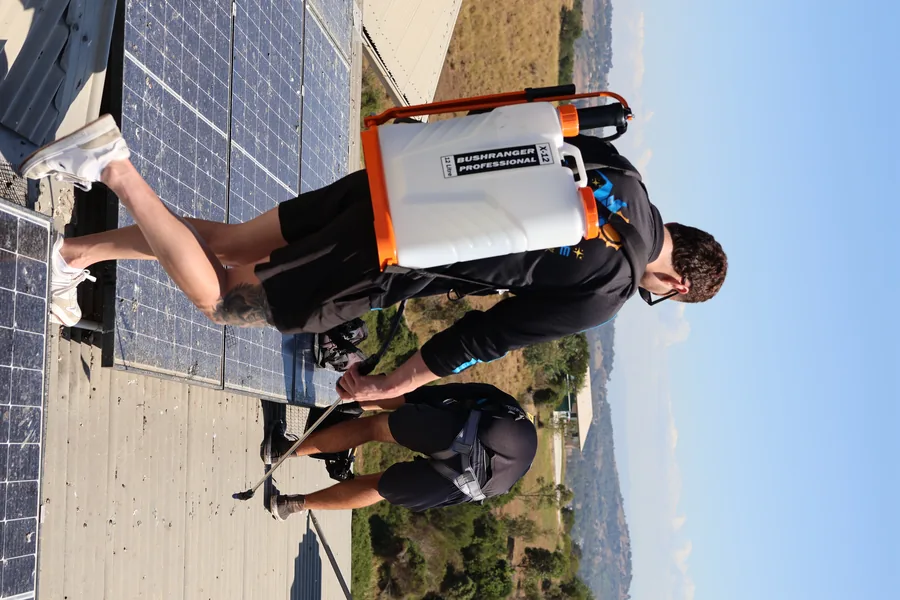
Early morning or an overcast day, when the glass is cool. Cleaning hot panels with cool water risks thermal stress on the glass, and water evaporates before you can rinse, leaving mineral spots.
Follow your inverter manufacturer's shutdown sequence before you start. Check your manual for any cleaning guidance too — some warranties specify approved methods.
A gentle hose rinse lifts loose dust and grit so you're not grinding it across the glass. Deionised or distilled water is ideal because it dries without leaving mineral marks; normal tap water is fine if you dry or squeegee afterwards.
Use a soft brush or microfibre pad on a telescopic pole. For stuck-on grime, a few drops of mild dish soap in water is enough — never abrasive pads, scourers or strong chemicals. Light pressure only; the anti-reflective coating scratches easily.
Rinse all soap off, then let the panels air-dry or draw a clean squeegee across them to avoid spotting. Restart the system per the manual.
Note your generation in the inverter app before and after. A clear jump confirms the panels were dirty; little change means soiling wasn't your problem and something else (shading or a fault) may be worth a look.
Most panel damage comes from a handful of well-meaning mistakes.
High-pressure water forces past the panel seals and into the frame, causing micro-cracks and moisture ingress. It's one of the fastest ways to void a panel warranty.
Scourers, hard brushes, vinegar at strength and industrial detergents all attack the anti-reflective coating. Mild soap and a soft pad is all the glass should ever feel.
Standing on glass causes hidden micro-cracks that degrade output for years. Clean from the roof edge or a pole — and if you can't reach safely from there, that's the signal to call a professional.
If your panels are on a single-storey roof you can safely reach from the edge or a stable ladder with a pole, a careful DIY clean a couple of times a year is perfectly reasonable. You don't need a special "Bunnings cleaning kit" — a soft brush, a pole and clean water do the job.
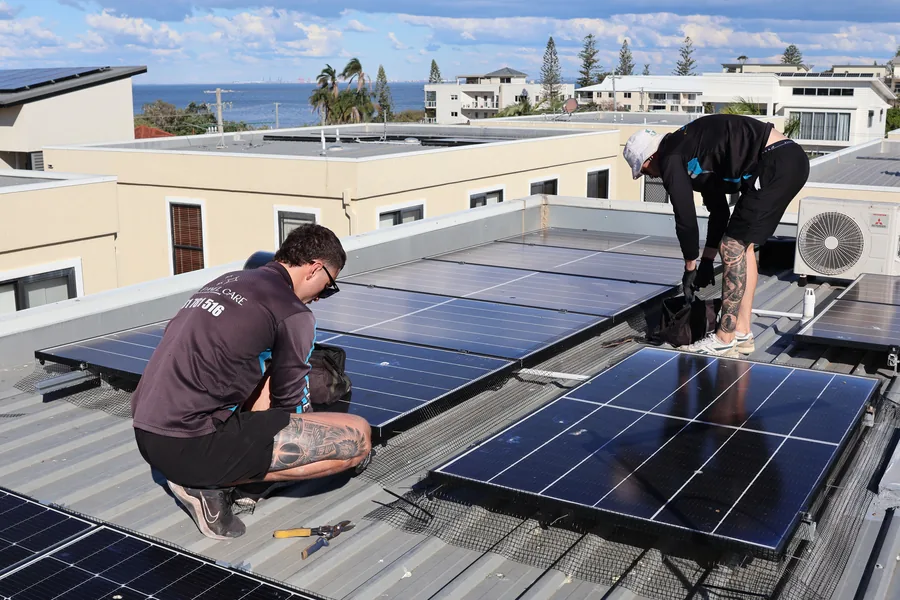
Get a professional in when the roof is two-storey or steep, when the panels are heavily fouled or have baked-on droppings, or when you'd simply rather not be up there. Our solar panel cleaning is from $15 per panel, fully insured, with the system isolated correctly and a before/after photo report — and the price is fixed up front. For body corporate and commercial rooftops we also handle commercial solar panel cleaning. Cleaning is one part of routine solar panel maintenance.
For most Australian homes, once every 6 to 12 months. Clean more often if you're near the coast, on a dusty or unsealed road, under leaf-dropping trees, or dealing with birds — and check the is cleaning worth it guide for how to judge it from your own output figures.
Tap water is fine, but hard water can leave mineral spots as it dries. Either squeegee or dry the panels afterwards, or use deionised/distilled water, which dries spot-free. Avoid letting any water dry on hot glass in direct sun.
No. Pressure washers drive water past the panel seals and can cause micro-cracks and moisture ingress, which typically voids the warranty. Use a gentle hose and a soft brush instead.
Only partly. Rain rinses loose dust but runs off a tilted panel, leaving a band of redeposited grime along the bottom edge and doing nothing for baked-on droppings or lichen. Panels that are rained on regularly still test dirty.
If the roof is high or steep, or the panels are badly soiled, yes — a professional clean is safer than a ladder and pays for itself in recovered output. Our cleaning is from $15 per panel, insured, with a before/after report. See is solar panel cleaning worth it for the full cost-benefit.
Insured, fixed-price solar panel cleaning from $15/panel, with a before/after photo report. Brisbane, Ipswich, Logan and Redcliffe.